
When we’re looking for sun cream, we usually base our choice solely on whether the product will offer enough protection against the sun. But what happens when the cream is no longer on our skin, but ends up in the water? Have you ever thought about how an everyday sunscreen affects marine life, or whether it’s even possible to create a formula that protects the skin whilst being kind to the ocean?
For eco-conscious brands, this is no longer a side issue, but is increasingly becoming a fundamental development challenge: how can strong UV protection be provided whilst ensuring that the impact on natural water bodies remains minimal?
How can sunscreens harm coral reefs during the manufacturing of cosmetics?
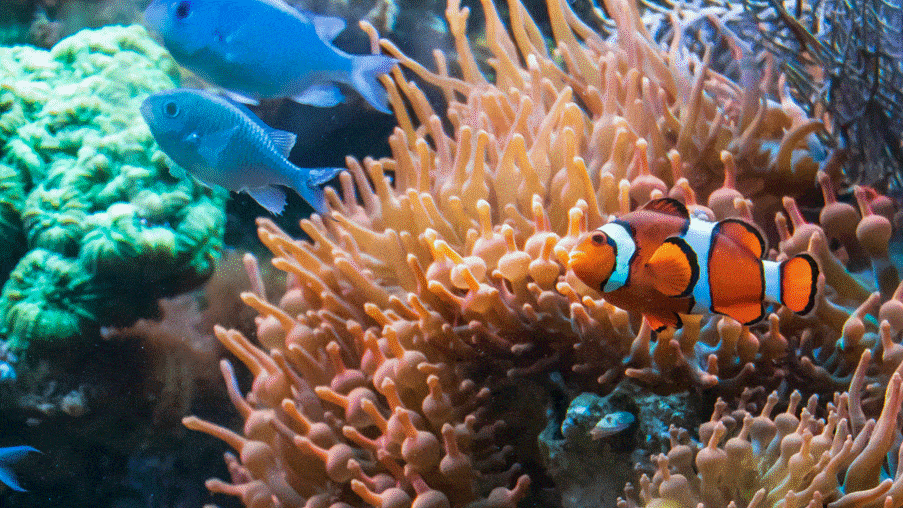
When the sunscreen washes off the skin into the waterwell, certain UV filter ingredients may come into contact with marine life, and may have an impact on sensitive ecosystems, particularly coral reefs. These living systems play a key role in the oceans, as they provide numerous are home to marine species.
Certain chemical UV filters found in conventional sunscreens, such as oxybenzone and octinoxate, according to several studies may be linked to the stress levels of the corals, which can weaken their resistance and slow down their recovery. This effect may contribute to coral bleaching process, which occurs when the corals lose their symbiotic algae, which live alongside them and provide them with their colour and part of their food supply.
The problem does not only affect coral reefs: Certain sunscreen ingredients may also affect other marine life. It has been shown that certain substances may accumulate in the bodies of fish, may affect the growth of algae, and thus the the balance of the entire marine food web may also be affected.
That is why it has become increasingly important to eco-conscious brands for them to think in terms of formulations that not only provide effective sun protection, but also place the least possible strain on marine ecosystems .
Why is it so difficult to develop a truly coral-friendly formula?
One of the key aspects of cosmetics manufacturing is the most difficult task to make a sunscreen that stable, easy to apply, effective and environmentally friendly all at once. Many mineral or alternative UV filter for example may give a denser feel, it is harder to spread, or it may leave a whitish film on the skin.
And this is where the development really starts to get complicated. Because consumers want a lightweight texture, high UV protection and a sustainable formula all in one. However, it is very difficult from a technical point of view to strike a balance between these requirements.
Stability is also a key issue: A sunscreen should remain effective in strong sunlight, in hot weather and when in contact with water.
What does „reef-safe” actually mean for an eco-conscious brand?
. „reef-safe” or „coral-friendly” These terms are appearing more and more frequently on sunscreens, but these there is no standard definition of it everywhere. This means that two brands can use the same label, even though their formulas do not contain exactly the same ingredients. For this reason, the eco-conscious brands it is particularly important for them that communicate clearly, what ingredients they use, and what criteria they apply when developing their products.
A truly in the development of eco-conscious sunscreen mineral-based UV filters are often used in the manufacturing process, such as zinc oxide or titanium dioxide is used, which form a physical protective layer on the skin. These ingredients do not absorb UV rays; instead, they reflect them. Another important consideration when formulating the product is that must not contain ingredients such as oxybenzone, octinoxate, parabens or microplastics, which are considered problematic for marine life in several places.
From in eco-conscious cosmetics manufacturing That is why it is not just the sun protection itself that matters, but also the fact that the formula how it behaves in the environment, what ingredients it is made from, and how transparent the entire development process is.

Why should you choose private label contract manufacturing for the development of eco-conscious cosmetics?
Coral-friendly and the development of eco-friendly cosmetics These days, it’s not just about choosing the right ingredients, but also about how much The entire cosmetics manufacturing process is underpinned by a solid professional foundation.
. Private Label in the model, the brands they don’t just construct the formulas on their own, but rather in a manufacturing environment work where there is an opportunity in-house developed or personalised as well as for creating recipes tailored to the needs of the target market.
This is particularly important when it comes to complex products such as sunscreens or specialist skincare products, where one must take into account efficacy, texture and environmental considerations all at once. The professional background, formulation expertise and manufacturing technology together ensure that the finished product not only works well, but also meet the expectations of informed consumers .
. Private Label provides an opportunity for the brands can grow faster and more securely offers products that align with an eco-conscious approach, whilst the entire process, from concept to finished product in a controlled, transparent and professionally supported environment is taking place.